

The adventure of a long restoration
In 2003, when Jean Bernard De Vaivre won his case against the State in the Council of State following poorly undertaken works, the State was ordered to compensate the owner based on its estimated value: the equivalent of the price of a 2CV of the time... which shows the state of ruin and peril in which the castle found itself at the time.
New owners will have to wait until 2016 to resume the rescue and, above all, to experience a great adventure...


2016
The study and preparation phase:
The architect in charge of the restoration of Meauce has been chosen and approved by the DRAC (Regional Directorate of Cultural Affairs). It is Charlotte Hubert. She will be responsible for the study, diagnostic, preliminary design, project design, and monitoring of the works.
You can find Charlotte's presentation in the blog.
The study phase will be completed and presented to the DRAC by mid-September 2016.
The study phase consists of:
- conducting a diagnostic assessment of the building's condition
- carrying out architectural analyses (which elements were or were not present in the 17th, 16th, 14th centuries), to define the target for restoration.
- conducting historical research to understand the evolution of the architecture of Meauce
- implementation of the project with cost estimation, priorities and their distribution over the 3 years of construction from 2017 to 2019.
Simultaneously with this project study and definition phase, the first emergency and site preparation work is being carried out. The first site meeting takes place on July 18th (just 16 days after the signing at the notary's office!). And the very next day, work begins to clear the space for scaffolding, restore a full view of the building, and remove and sort the rubble.
- The work to secure the framework is being carried out by Les Métiers du Bois
- the safety work, masonry and debris removal by the Jacquet company from Bourges
- The pruning work was carried out by the Kremer company of Premery and by the Paysages et Cimes company of Langeron
- and for everything else, family, friends and a few volunteers!
On September 13th, representatives from the DRAC (Regional Directorate of Cultural Affairs) and the ABF (Architects of the Buildings of France) visited Meauce. Charlotte Hubert presented the project and the restoration approach. The project was well received by the DRAC, which is expected to accept our proposal.
In August, some lovely surprises were uncovered, such as a 15th-century molded door.
In September, a vast and impressive access road for machinery and scaffolding was created.
Scaffolding has been erected in the castle courtyard to clear away the rubble and old woodwork. Almost all the rubble had already been removed by the end of September. Enthusiasm is at its peak!
1st quarter 2017
Obtaining permits and organizing the start of construction
Two applications have been submitted to obtain the necessary permits to begin the work.
The Château de Meauce was fully listed by decision of the National Classification Commission on December 12, 2016. However, the official decree has not yet been published. Therefore, we need to prepare and submit two applications: one for the listed sections and the other for the registered sections. The application for the listed sections is sent directly to the Regional Directorate of Cultural Affairs (DRAC), while the application for the registered sections is submitted to the town hall.
This dual process demands even more effort, and above all requires double explanation and double monitoring to avoid delays. Even more challenging, the analysis differs significantly between the perspective of building and environmental law (for areas within a protected natural zone) and that of the heritage code for listed sections.
In short, after a few tense moments related to the protected natural site of "Bec d'Allier," everything moved at record speed. The various stakeholders took the time to discuss Meauce together, addressing their respective questions, and the DRAC (Regional Directorate of Cultural Affairs) orchestrated this with remarkable efficiency. We sincerely thank ABF (Architect of the Buildings of France) Philippe Lamourère, the Mayor of Saincaize Gérard Aubry, Mr. Régis Wenzel for the DRAC, and the DDT (Departmental Directorate of Territories) of Nièvre for this collective achievement!
The only remaining issues to address are a few requirements from the DRAC (Regional Directorate of Cultural Affairs). Those concerning the restoration approach have been incorporated into the project (e.g., removing the proposed laminated wood in areas where no trace of the original timbers remains, such as collapsed ceilings and roof trusses; consequently, a complete restoration in oak). However, the requirements from the SRA (Regional Archaeology Service), demanding preventive excavations, have increased the project cost by €120,000 and necessitate a postponement of at least six months. Discussions are underway with the DRAC to explore ways to reduce the cost and its impact on the work. Everyone is making an effort, and the bill has been reduced by 33%, with exceptional funding obtained from major retailers covering the remaining cost. The report is a goldmine of information that we are very fortunate to have.
The work will finally begin two and a half months ahead of schedule. Indeed, on March 21st, all the tradespeople met to organize, plan and prepare this first phase of work.


May 6-7-8, 2017
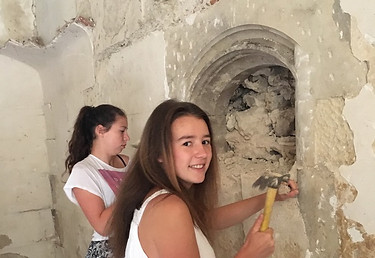
Volunteer workcamps
You too can participate in a friendly and convivial way in the rescue of Meauce.
We have received numerous requests from people of all ages and from all regions to collectively share a concrete moment of action in support of the heritage of Meauce.
We therefore organize small, simple workcamps for a maximum of 40 people. See the photo report below. Contact us for future projects!


Summer 2017
The work is progressing at a good pace!
The construction work is progressing on schedule despite the summer break.
The scaffolding installation, which took longer than expected, reduced the two-month lead over the 2016 schedule to just one month. But that's already quite an achievement! Congratulations to all the companies involved. Now the challenge is to maintain this lead and complete the first of the three phases of work by the end of March 2018.
This first phase is certainly the most important; it concerns the south façade of the Château, the one overlooking the Allier River, with three sets of four large windows, opened in the 17th century, in the perimeter wall, which is nearly 3 meters wide in places. This area also includes floors that have disappeared, and especially the turrets, under which the roof structure needs to be completely replaced in one of them.
The ivy covering the old walls has been completely removed from the south facade, revealing severe damage to the masonry. The walls are therefore heavily damaged in places and require more extensive repairs than anticipated. The large cracks on the ground floor have already been addressed, with a pleasant surprise! These cracks were related to the stone facing installed on the perimeter wall, which was pierced when the large windows were created. However, the interior of the perimeter wall shows greater fragility. Large quantities of lime grout were poured into the heart of these old walls, using garden hoses and water bottles to reinforce them. The team of three masons from the "Jacquet" company worked tirelessly to soak the old perimeter wall. During the summer, they managed to secure and reinforce the tops of the walls for the carpenters, to rebuild part of the walkway in this area and in the process discovered a magnificent mullioned window which building archaeologists date to the 13th century.
Meanwhile, the two carpenters from the company "Les Métiers du Bois" are hard at work. The framework of the southern section is encased to allow for its safe, piece-by-piece dismantling. A floor is being laid, and most importantly, three of the four old main beams that supported the floors are being cut and removed. This is bad news! We had hoped to keep more than one out of four. The situation is the same for the joists. In short, more new wood will be needed. This is a blow to the budget! Especially since the one that is being kept needs to be reinforced at one end. A treatment with a highly resistant resin is being applied to the beam, which will thus be saved, thanks to a technique developed by the company "Renofors".
By the end of July, the walls of this entire area were reinforced. The four main beams supporting the floors were in place.
And the first of the six floors to be laid has been installed. In August, the construction site will stop for three weeks. We feel that things are in good hands and well underway.


The administrative life of the project brings good news and some concerns about the future of the discoveries!
Spring had left us with the fear of a budget overrun for the archaeological research. Fortunately, the Regional Archaeology Service and the DRAC (Regional Directorate of Cultural Affairs) of Bourgogne-Franche-Comté mobilized to find a solution. The two preventive archaeological excavations ordered for February and March 2017 will be funded by the National Fund for Preventive Archaeology. Therefore, there will be no impact on the restoration budget. We also faced the risk of a delay to the work during the archaeological research. Here again, the heritage departments of the Ministry of Culture found a solution by allowing the restoration companies and the archaeologists to work together simultaneously. This proved extremely beneficial. In agreement with the Regional Archaeology Service, we selected the "Center for Medieval Studies" to conduct the building archaeology research. We look forward to sharing the main conclusions of this report on this page!
Each passing month brings interesting discoveries, adding further character to the old castle. For example, in April, a nearly intact 15th-century arched doorway was discovered; in May, a 13th-century mullioned window; in June, a stone door frame and two 12th-century windows; and in September, the 14th-century dolium and latrines. None of these elements were visible in the 18th century, the period chosen as the guiding principle for the restoration. Extensive discussions then ensued regarding the space to be allocated to these discoveries. Finding a balance between what could be preserved to enhance our living space in the castle and respecting the 18th-century architecture proved challenging, but the exchanges were fruitful. The dolium will remain forever underground, and the 12th-century door and windows will remain hidden. However, our objective is to preserve the mullioned window and the 15th-century doorway. The architect's work to address this while respecting the 18th-century aesthetic is eagerly awaited!
- The colors, the debate about colors begins. We're far from the finishing touches, but we have to restore the castle to its 18th-century colors. This means painting the beams and joists as they were in the 18th century. Luckily, the 18th century is 100 years old... and we should avoid a bad yellow in favor of a blue-gray. But we're far from having the raw beams and joists we had hoped for.
Winter 2018
Les couvreurs sont là !


The timber frame of half the south facade has been rebuilt, with 40% new wood. This 1380 timber frame has therefore been largely saved and is now restored. The two large St. Andrew's crosses, which we feared losing, are still there and have been reinstalled.
What a joy to see this beautiful rafter-framed truss restored, straightened and reinstalled for many centuries!
In December, the roofers, Stéphane and Renaud, took possession of the premises and completely stripped the roof structure to prepare for the slate roofing which would take place from January 15, 2018.
Meanwhile, there are more carpenters, 4 of them permanently on site (Thierry, Alain, Charles and John).
The task ahead is enormous for them.
The flooring is behind schedule and needs to be finished. The new molded joists, replacing all the missing ones, are here, and at the end of January, the first one was laid on the partially preserved wall plates, all of which had to be repositioned and secured. During the same period, the carpenters had to dismantle the framework of the large turret piece by piece.
It is on the ground floor of the old castle, in the moat, which almost reached its highest point again at the peak of the floods.
Charles has the wonderful task of reassembling the framework of this spiderweb-shaped structure, spanning 4 floors.
After replacing the lintels and sills of the 12 bays that required it, Julien and the masons are preparing the tops of the parapet walls to receive the new timber frame next March. The three masons must also reinstall the stone cornices and reinforce the walls by anchoring the large main beams inside the parapet walls. Between rain showers, they have only a few hours to restore the three chimneys of this first phase. Finally, they are repointing the south facade.
In four months, the work has been colossal, and with a hostile climate—rarely have so much wind and rain battered these old walls. Like the entire team, they persevered! The schedule is tight...but overall, we're still on time...
The moment of truth will be the successful installation of the large turret before the end of March and the relocation of the scaffolding to launch the second phase by the beginning of April.
Winter 2019
The first phase of the work is complete!
The mild winter of 2018-2019 was a stroke of luck for Meauce.
The roofing of the south facade has now been completed since the end of February 2019, as well as that of the three turrets.
The western timber frame has been exposed to the elements, allowing for water damage during its restoration. Fortunately, the dry and mild weather in February enabled rapid progress in this delicate phase, as shown in the video below.


Summer 2019
The second phase of the work begins!
After removing the few old tiles still present on the roofs of the round castle outbuildings, the carpenters restored the rest of the old framework by lining it with new wood.
The west chimney has been raised by 2 meters and the one to the east has been restored to its crown.
The final floors are finished.
Summer 2020
Interior renovations are beginning... and despite COVID, the goal of living in Meauce for Christmas 2020 remains!
Summer 2020 was impacted by COVID-19, and the work was delayed with a two-month work stoppage. Nevertheless, we still hope to move into the castle by Christmas 2020.
The companies worked flat out, and during these few months, new plaster was applied to the interior facades of the castle, some twenty windows were reinstalled, the ceilings were painted, and the first restored doors were put back in place. The interior plaster was tested and approved. And even all the screeds were poured over the underfloor heating system.
The air-to-water heat pump can be delivered; the pipes have been installed!
The electrical installation is well advanced.
Between September 2019 and February 2020 the framework of the 13th tower was installed, and the roofing of the entire tiled section was completed.
In February the scaffolding disappears and finally frees the castle after more than 30 months of presence!


2021
The interior work is nearing completion, but historical and architectural discoveries, along with COVID-19, are slowing the pace of construction.
Christmas 2020 was the target date for moving back into the castle… Clearly, Santa Claus doesn't exist… and the completion date for the interior restoration of Meauce Castle has been pushed back to June 2021. In the end, and with many compromises, it will be December. A year's delay on such a project—if we had been told from the start, we would have signed on the dotted line without hesitation!
It must be said that COVID-19 significantly disrupted the organization of this lengthy project, which was already showing signs of slowing down… and furthermore, the discoveries have considerably altered the objectives of the renovation work. The painted decorative frieze, the large sculpted fireplace dating from the early Renaissance, the dolium, and other finds necessitate a rethinking of the project. All of the castle's remaining missing windows have been restored.
It wasn't planned, but at the end of 2020, the "France Relance" recovery plan, part of the COVID-19 response, came to the rescue for these major, unforeseen renovations, as well as for the Mansard-roofed barn and the dovecote, which are also in danger of collapsing. This excellent news at the end of 2020 is now being rolled out into 2021 and must be completed before the end of 2023. It's also causing a lot of stress, because the France Relance plan covers 50% of the expenses, and the remaining balance needs to be found very quickly, at the same time as the work begins, all within a short timeframe… a race against time has begun!
In April 2021, the painted decorative frieze was restored and presented to the public in May. In June, work began on the large fireplace and the windows.
We're launching a work-integration program to add a social dimension to the project... The program is recruiting its first beneficiaries, who are being supported by the employment agency. Meauce is contributing to economic integration, and we're quite proud of that... it's not common, yet another small administrative achievement!
However, the barn renovation project with the mansard roof is behind schedule; the funding is far from secured, and it's too risky to carry out four phases of work simultaneously. We prefer to postpone it by six months and wait for the completion of phases 3 and 4 before starting phase 5.
2022
The time of the Dovecote and the fabulous barn known as the Mansart barn
Le pigeonnier poursuit sa longue et lente restauration.
Nous avons trop peu de personnes qui travaille sur ce chantier d'insertion et l'hiver en a vue partir quelques uns. Une longue phase de consolidation se termine en 2022 pour éviter au vieux pigeonnier de 1636 de tomber à terre.
Les équipes professionnelles sur la grange, elles avancent à une vitesse de record. Démarré avec 6 mois de retard, le chantier du pigeonnier sera presque terminé en décembre. La surface au sol est de 300 mètres carré, toute la charpente a été demontée et remontée avec près de 50% de bois neuf. La corniche en pierre a été complètement restaurée, les baie modifiées ont retrouvé leur aspect initial et l'enduit de la façade sur cour est refait avant les gélées, dès mi novembre.


2023
A race against time in the dovecote and big questions about the barn
The pace has definitely slowed down; the immediate crisis is behind us. Despite everything, the barn was delivered on February 1st, 2023, only a month late. But the optional extras and windows haven't been installed yet. We've managed to secure the remaining funding, but the architect has finished their work, and we need to find another one. It will take six months, and we still haven't received approval to resume work... Will the barn windows ever be installed?
For the dovecote, the pace quickened with spring, and the plastering was almost finished by summer. The ladder and various woodwork were ready to be installed. The skylight was completed—it's magnificent! The concrete slab was removed, and the stones were laid to support the roof lantern. We can hope to finish, despite a six-month delay! The project will have lasted 30 months, but more than 24 people will have participated in a work-integration program, and some have already found stable employment.
